Using Inspector
Wizard workflow (Input → Preview → Export → Prepare)
Step 1: Input — three modes
- Generate — natural language → scenario (OpenAI GPT-4o-mini cloud, or Ollama local), auto-validation and error correction, optional clinical context for accurate thresholds.
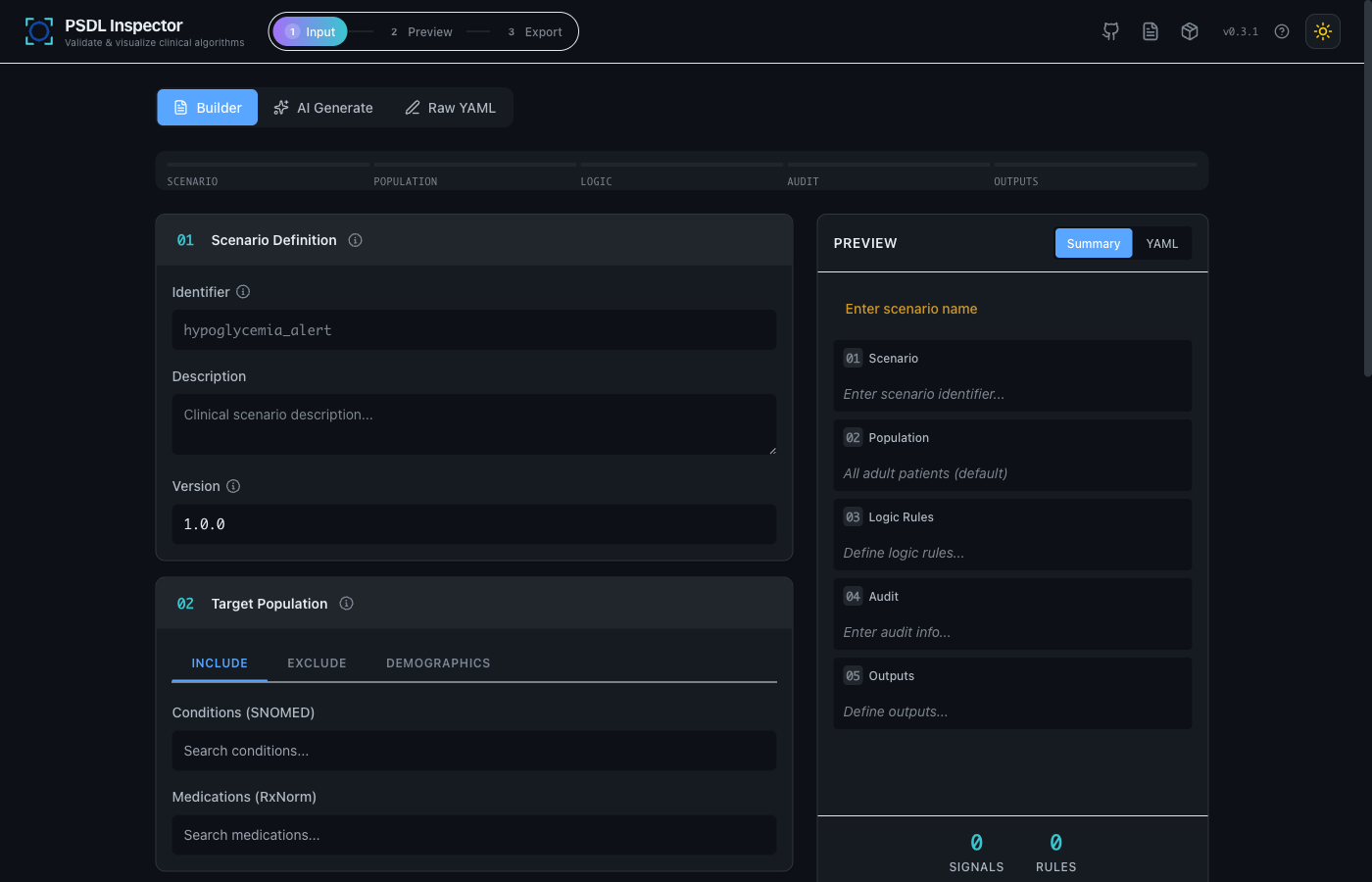
- Builder — constrained visual builder: signal selection with OMOP search, trend config, logic rules with severity, outputs, and the audit section (intent, rationale, provenance).
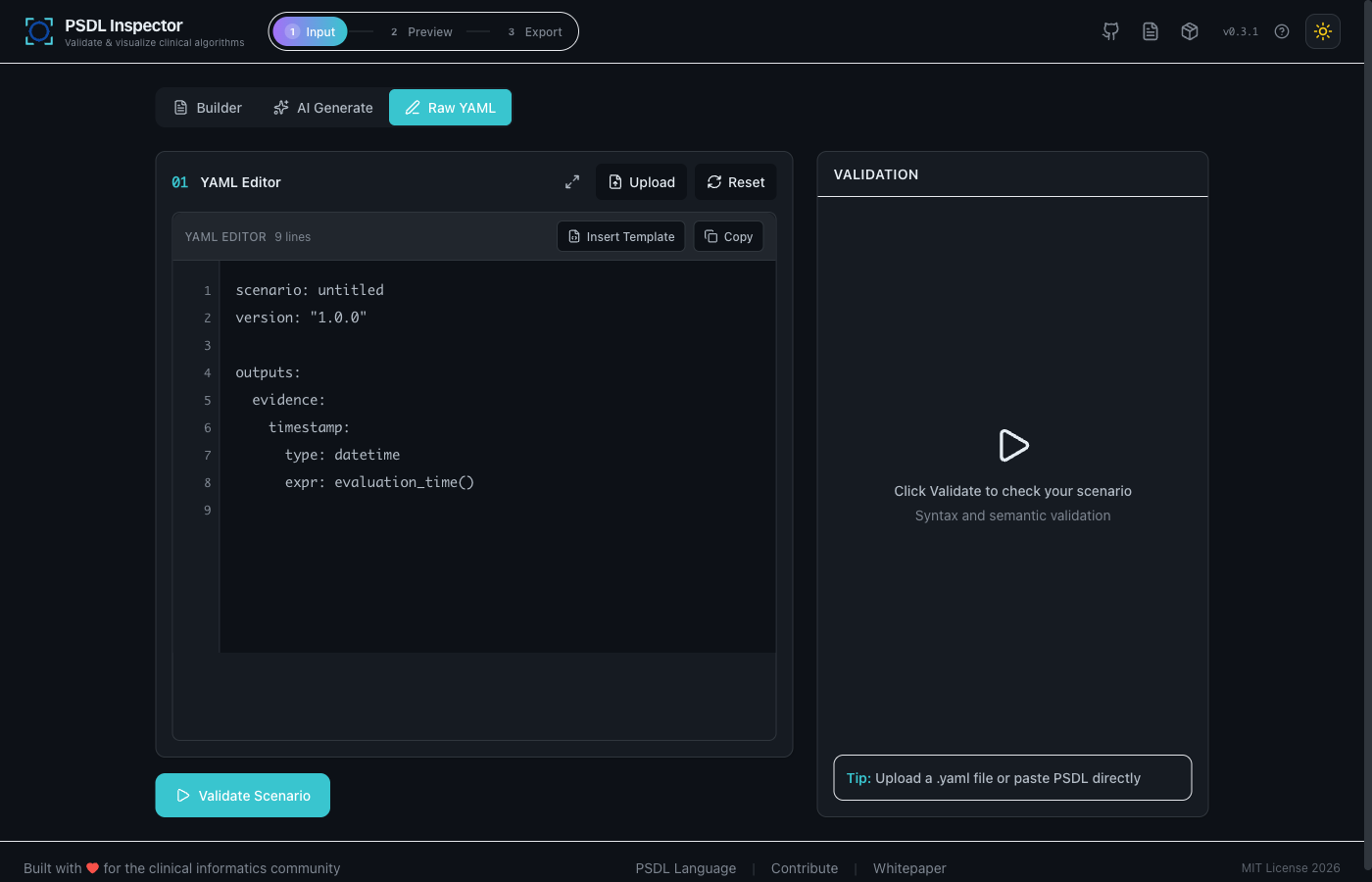
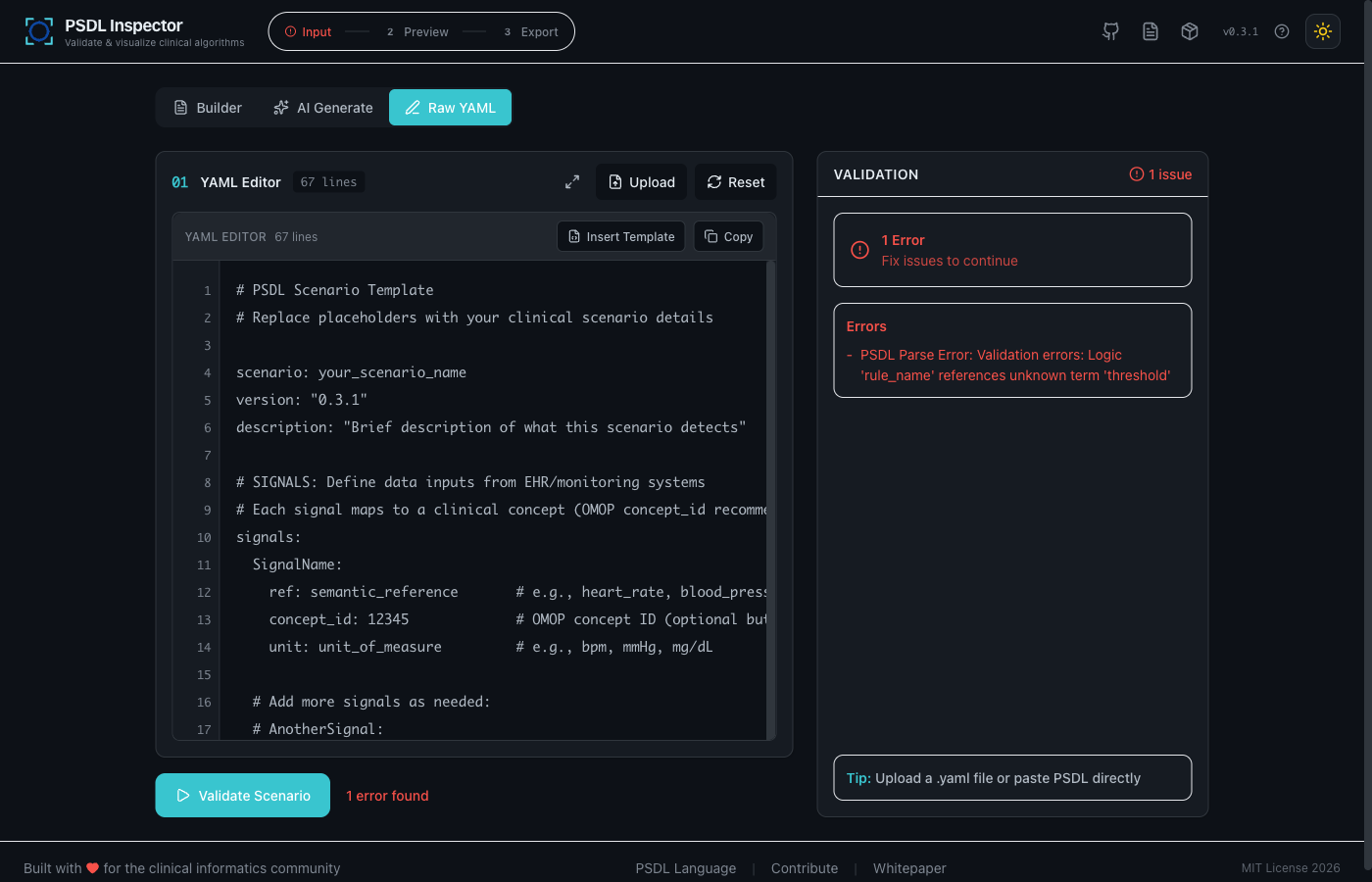
- Editor — manual YAML with CodeMirror: syntax highlighting, auto-completion, line numbers, template insertion, real-time validation.
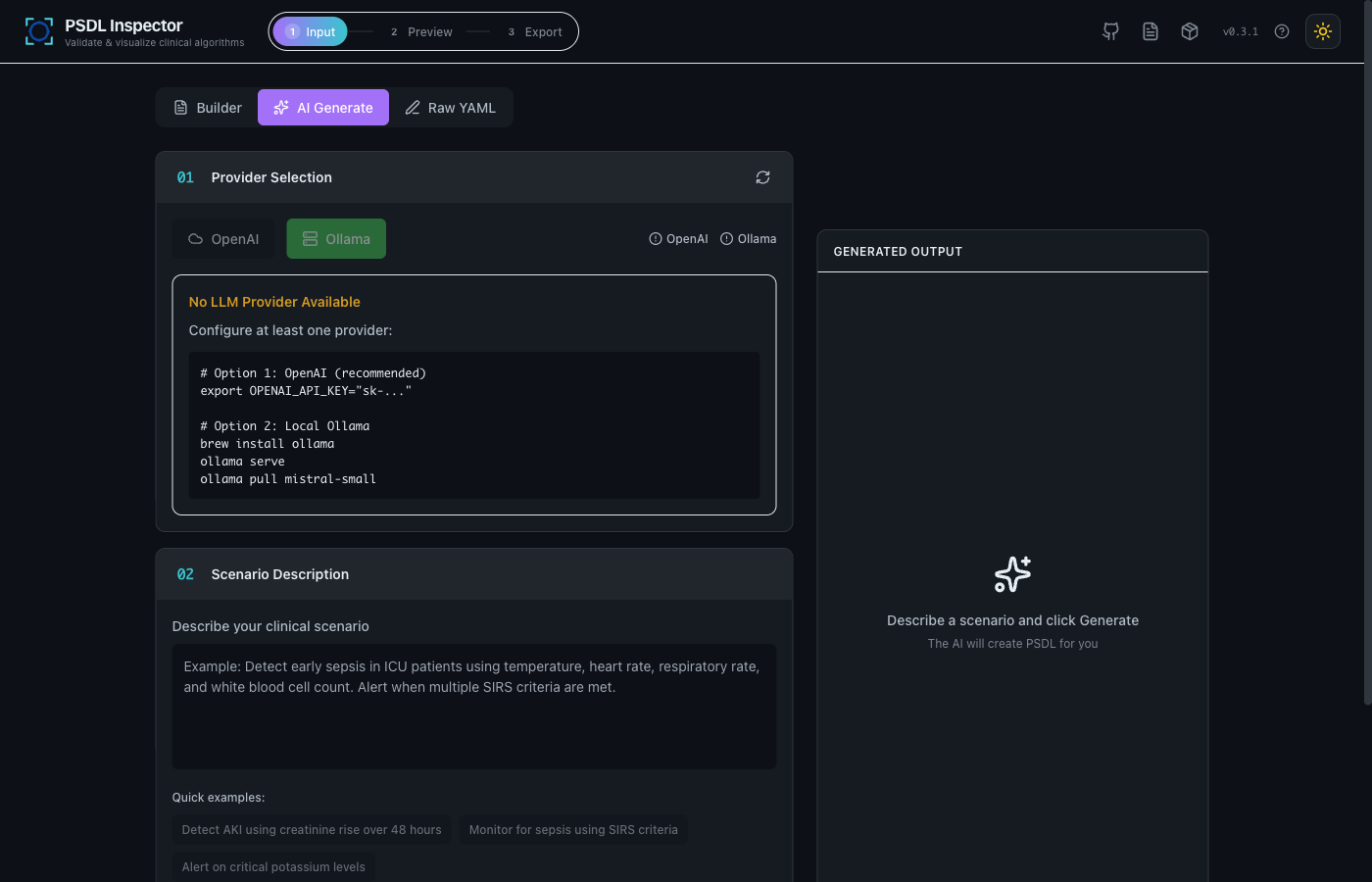
Alternatives to Generate: the Builder (visual, with OMOP search) and the raw YAML editor. Validation runs live — flagging errors as you type, green when it passes.
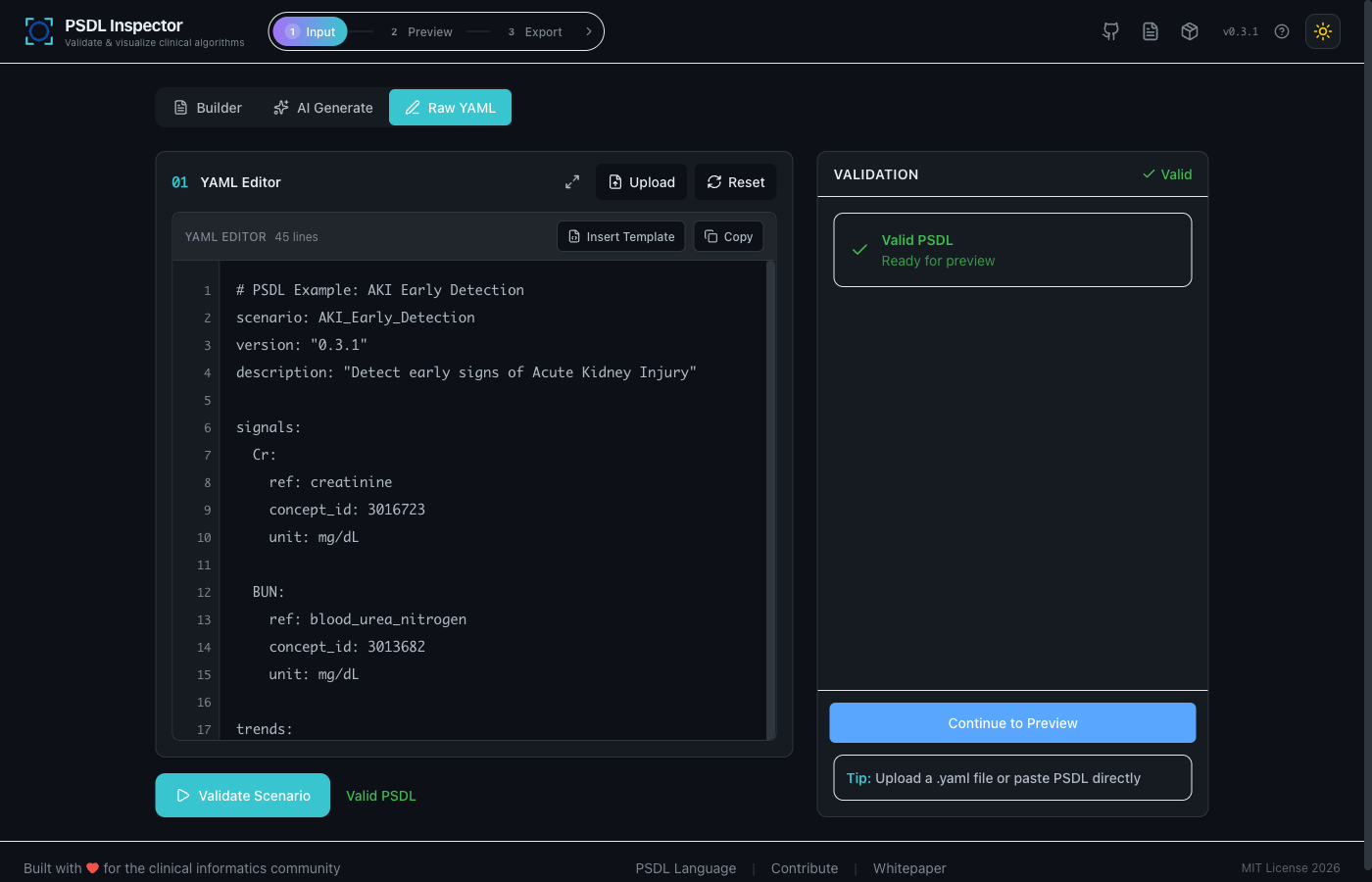
Step 2: Preview
- Outline — tree of signals, trends, and logic with dependency tracking.
- DAG — interactive ReactFlow graph: custom node shapes, severity-based coloring, hover detail panel.
- Bundle — certified audit bundle preview with checksum and governance checklist.
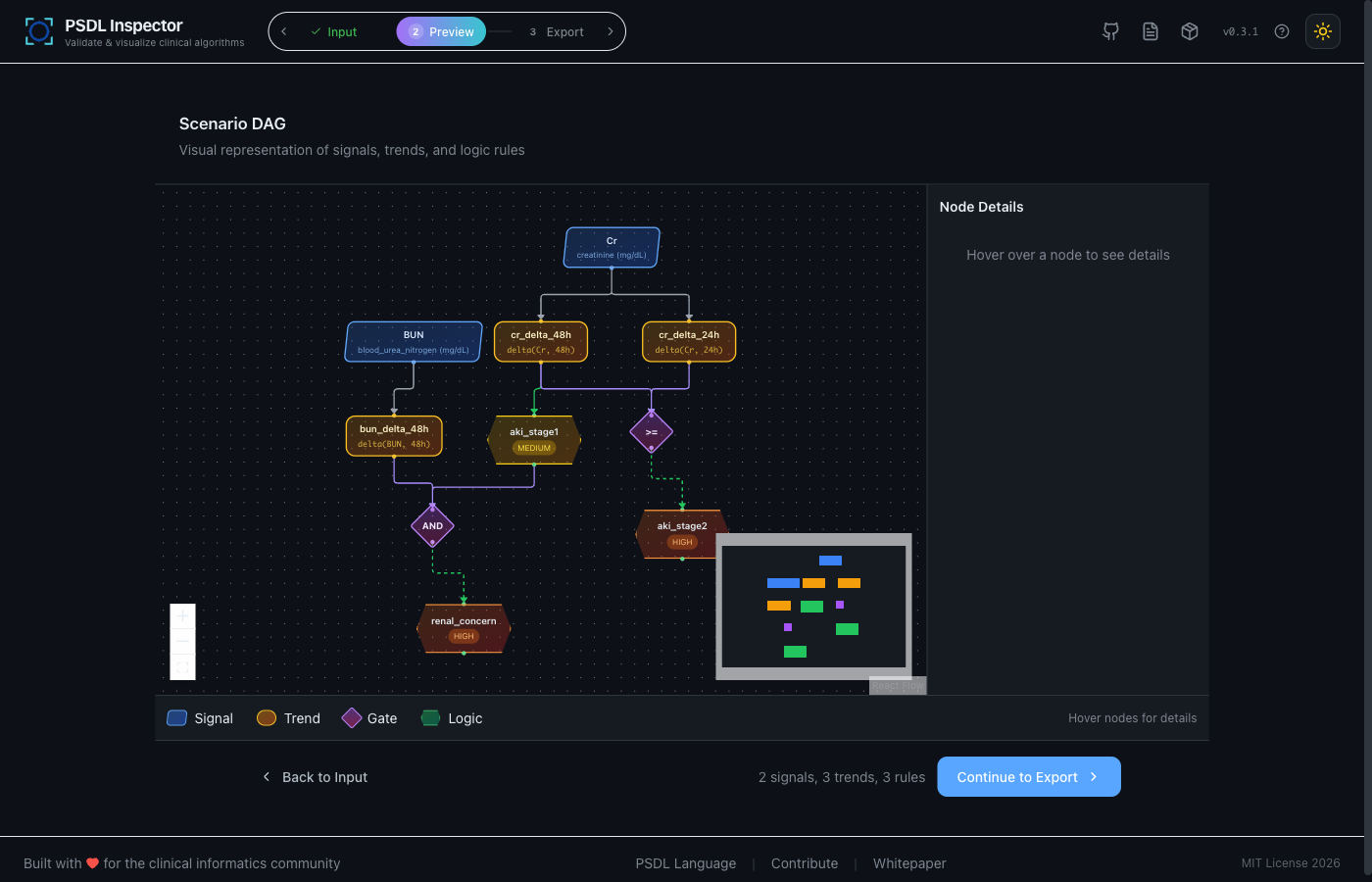
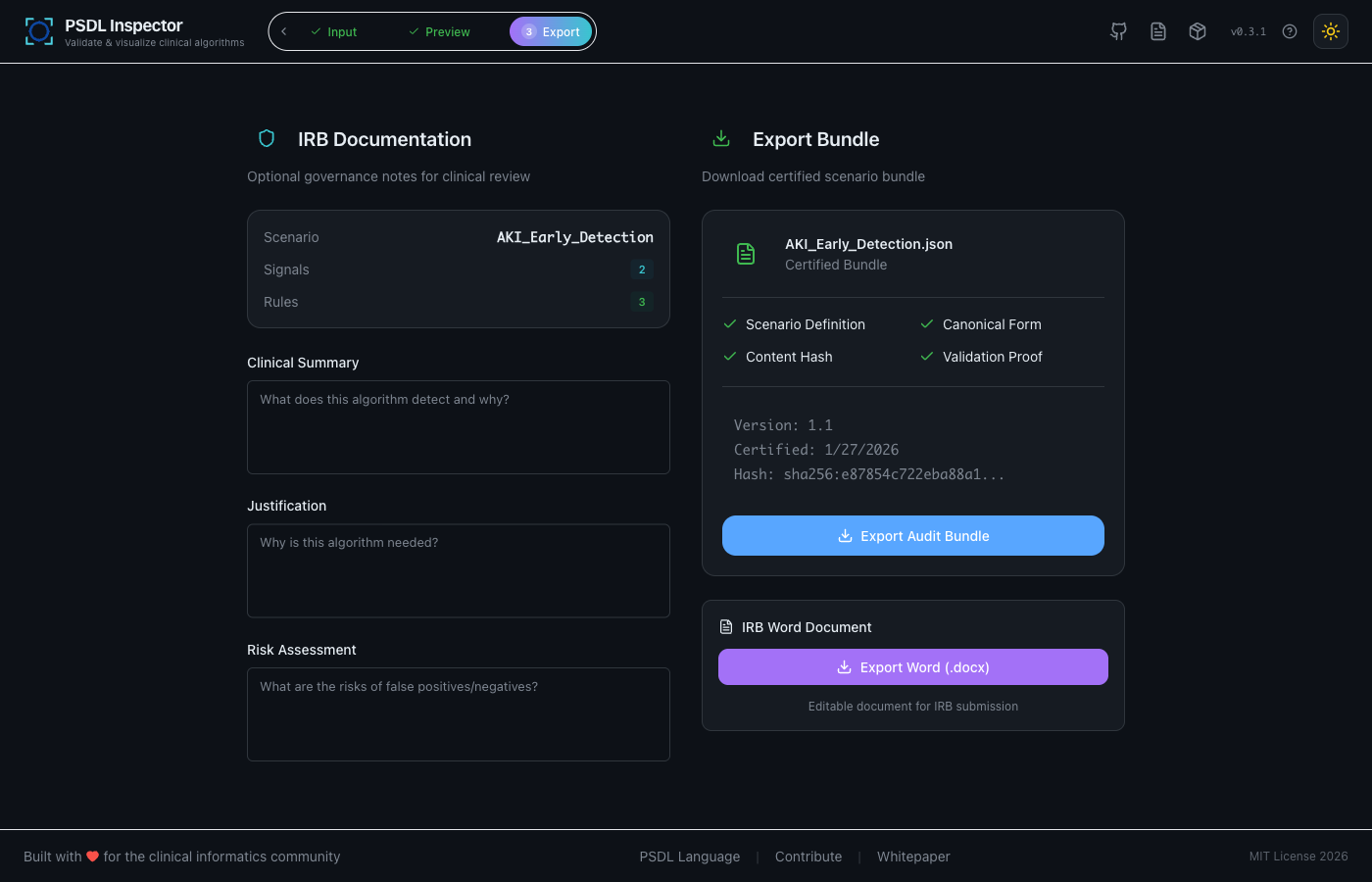
Step 3: Export
- Governance Documentation — clinical summary, justification, risk assessment.
- JSON Bundle — checksummed certified audit bundle with terminology anchors.
- Word Document — AI-enriched IRB doc: executive summary, clinical background, algorithm overview, data elements, safety considerations, limitations, technical appendix.
Step 4: Prepare
- Data Catalog — browse an Observatory-scanned data lake (read-only).
- Preflight — offline or live-DB SQL cost/risk check before extraction.
Terminology anchoring engine — BioLORD (default) vs legacy
OMOP anchoring (and vocab search) can run on two engines, set via ANCHORING_ENGINE in docker-compose.yml (or the backend environment):
biolord_v2(default) — highest quality (BioLORD-2023 embeddings + clinical reranker). The embedder is baked into the image; a ~1.7GB concept index downloads once on the first anchor and is cached in thevocab_cacheDocker volume (first anchor ~100s, instant after). Best for accuracy.- **
` (empty) → legacy** — lighter and offline (no 1.7GB download), but lower-quality matches (no domain reranking). SetANCHORING_ENGINE=` to use it.
Either way, the cold cost is one-time; subsequent anchors are instant. Generation-time vocab enrichment is off by default (GENERATE_SKIP_ENRICHMENT=1); OMOP binding still happens at export anchoring.